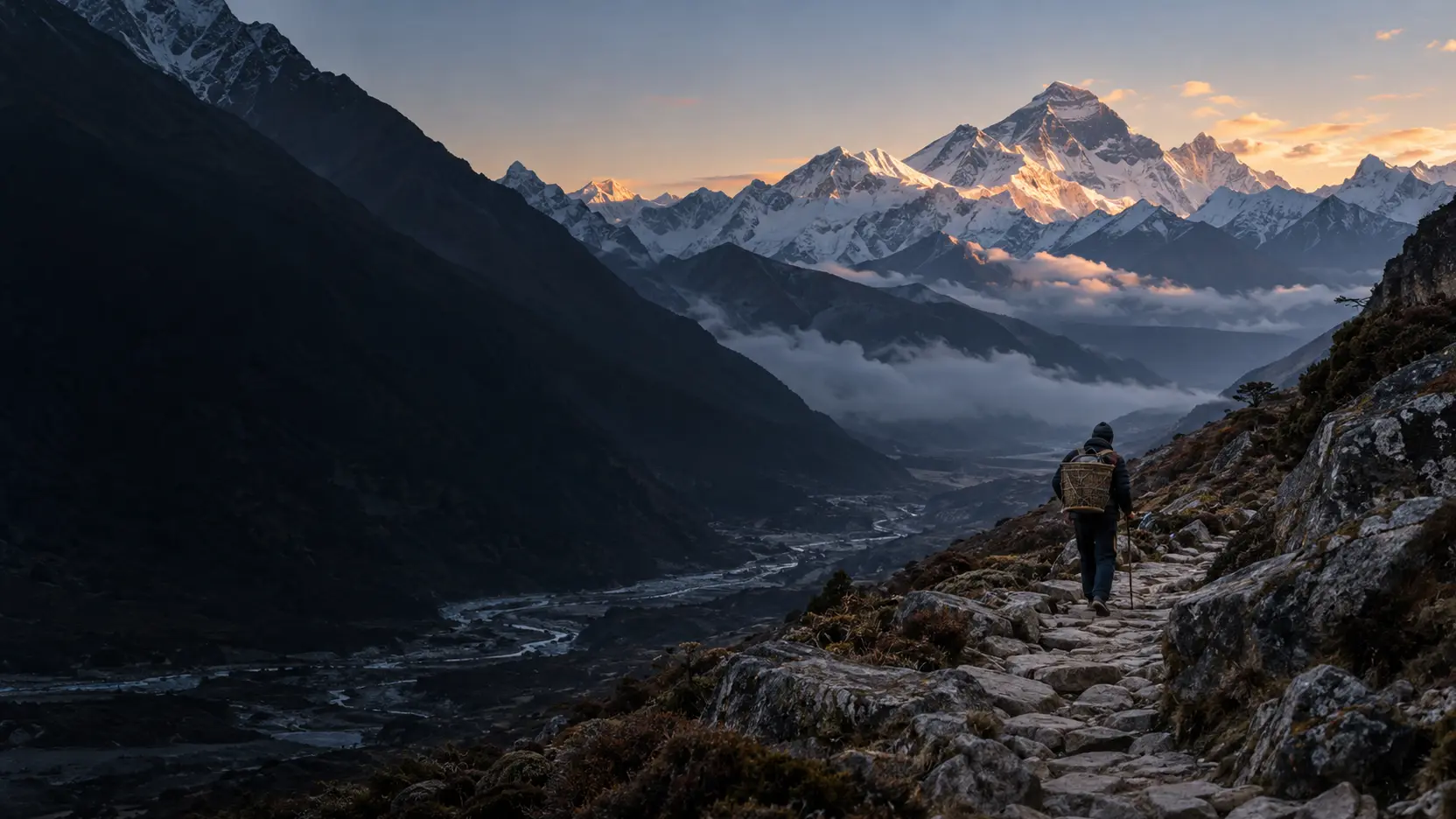
PRIVATE BUDDHIST & CULTURAL JOURNEY · KHUMBU, NEPAL
01 / THE JOURNEY
MEANING BEFORE MOTION Khumbu should not be reduced to Everest. Academic research describes overlapping sacred geographies in the region. One centers on Khumbi Yul Lha, a local territorial deity associated with the sacred mountain above Khumjung. Another comes from Nyingma Buddhist institutional traditions that identify Khumbu as a beyul, or hidden sacred refuge. Within Nyingma Buddhist tradition, Khumbu has been interpreted as a beyul. This understanding exists alongside local Sherpa sacred geography associated with Khumbi Yul Lha. These are related through place, but they should not be flattened into a single account.
AT A GLANCE
DURATION
Custom duration · provisional route
PACE
Private pace · acclimatization-led
JOURNEY TYPE
Private Buddhist pilgrimage & cultural journey
REGION
PRIVATE BUDDHIST & CULTURAL JOURNEY · KHUMBU, NEPAL
02 / MOMENTS THAT STAY
KHUMBI YUL LHA Khumbi Yul Lha is documented in scholarship as a local deity connected with the territory and sacred geography of Khumbu. Nepal Tourism Board describes Khumjung as lying at the foot of sacred Khumbila. No origin legend, date, miraculous account, or ritual requirement is asserted here. THE BEYUL TRADITION A beyul in Tibetan Buddhist tradition refers to a sacred hidden refuge associated especially with Nyingma religious geography. Some Nyingma Buddhist institutional traditions identify Khumbu as a beyul. Academic research documents coexistence and negotiation among monastic Buddhist interpretations, localized Sherpa sacred practices, and territorial traditions associated with Khumbi Yul Lha. TENGBOCHE Tengboche is a major Buddhist center on the main Everest route. Nepal Tourism Board describes it as a 20th-century institution: its main temple was destroyed in the 1934 earthquake and rebuilt, then the monastery burned in 1989 and was rebuilt again. Tengboche is well known for Mani Rimdu, an important Buddhist festival involving ritual gatherings and masked dances. Annual timing and visitor access require confirmation. SACRED LANDSCAPE Monasteries, mani walls, chortens, prayer wheels, sacred mountains, and village religious life make meaning visible in the landscape. Individual monuments and practices are approached on their own terms, without invented symbolism.
03 / THE ROUTE
PROVISIONAL PILGRIMAGE ROUTE Day 1 — Kathmandu arrival and journey briefing Day 2 — Travel toward Lukla; begin walking into the lower Khumbu Day 3 — Continue toward Namche Bazaar Day 4 — Namche acclimatization and cultural orientation Day 5 — Khumjung / Khunde area and the sacred landscape associated with Khumbila Day 6 — Trek toward Tengboche Day 7 — Tengboche monastery and surrounding sacred landscape Day 8 — Flexible cultural or monastery day, or nearby village exploration Day 9 — Begin the return toward Namche Day 10 — Continue toward Lukla Day 11 — Return to Kathmandu Day 12 — Kathmandu reserve and reflection day Day 13 — Departure The route is provisional and customizable. Walking stages, religious visits, access, accommodation, domestic aviation, and duration are confirmed only in the final operating plan.
04 / THE COMFORT
Kathmandu: premium hotel accommodation. Khumbu: carefully selected, best-available mountain lodges appropriate to each location. Remote mountain accommodation should not be understood as offering the same standards or room categories as premium hotels in Kathmandu. GUIDE & CULTURAL INTERPRETATION Led by an experienced local trekking team, with cultural interpretation arranged where appropriate. Monks, religious teachers, private blessings, ceremonies, and specialist interpreters are not promised unless separately confirmed.
05 / MEANING AND PLACE
VERIFIED HISTORY Nepal Tourism Board identifies Tengboche as a major Buddhist center on the Everest route and documents its 20th-century construction, the destruction and rebuilding associated with the 1934 earthquake, the 1989 fire and subsequent rebuilding, and its association with Mani Rimdu. NYINGMA RELIGIOUS INTERPRETATION Some Nyingma Buddhist institutional traditions identify Khumbu as a beyul. No primary lineage text naming Khumbu has been verified for this page. SHERPA / LOCAL TRADITION Khumbi Yul Lha belongs to local territorial sacred geography associated with Khumbu and the mountain above Khumjung. Detailed worship practices and oral histories require locally attributed sources. ACADEMIC INTERPRETATION Lindsay A. Skog’s ethnographic research documents these overlapping sacred geographies and the cultural negotiation between them.
06 / THE DETAILS
INCLUSIONS
PILGRIMAGE ETIQUETTE Follow guidance from local guides and monastery staff. Ask before photographing ceremonies or interiors. Move respectfully around religious monuments, avoid touching sacred objects unless invited, dress appropriately when entering monasteries, and maintain quiet during prayer or ritual activity. The final proposal will specify private guiding, trekking support, transport, accommodation, meals, permits, cultural interpretation, and any requested enhancements. No private religious access is implied.
EXCLUSIONS
WHAT THIS JOURNEY IS NOT This is not a religious retreat led by Mountain Beyul, a promise of spiritual initiation, a monastery residency, or a fabricated “mystical Everest” experience. It is a private cultural and pilgrimage journey: an opportunity to encounter a living religious landscape respectfully, through travel shaped around context, place, and local practice. Services, access, and encounters not specifically confirmed in the final proposal are not included.
07 / WHEN TO TRAVEL
Travel timing is planned around trekking conditions, weather, monastery access, and the guest’s preferred pace. Exact pilgrimage timing and religious access may affect the final route. FESTIVAL OPTION Travel dates may be planned around Mani Rimdu when appropriate. Festival dates, programs, and visitor access vary and are not guaranteed.
YOUR JOURNEY, YOUR WAY
Every private journey begins with a conversation. Tell us what matters to you, and we will shape the details together.
Design My Sacred Khumbu Journey